









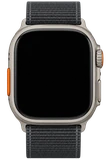





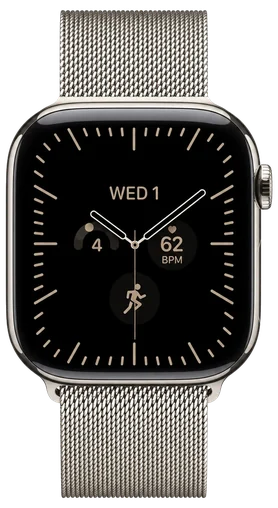
Apple calls it a Health Sensing System, and it is a sensor redesign rather than a watch redesign. The electrode has more surface area for better skin contact during an ECG, the photodiodes are arranged in a ring to capture light more efficiently, and the green LEDs are larger and more power efficient so a reading holds up while you move. What that buys is frequency. Heart rate is now measured every five seconds throughout the day, 60 times more often than before, and heart rate variability is sampled up to 24 times more often, with separate recovery and overall values in the Heart Rate app. MacRumors ran through all eight changes Apple detailed for the Series 12 and Ultra 4.
The VO2 Max test is the odd one out. It asks you to set up your iPhone so its camera can watch you perform a series of exercises, then delivers the result immediately alongside what the watch collected. Apple also rebuilt the pedometer with new machine learning models, which it says improves distance accuracy for indoor workouts and all-day step counts, and added a live steps complication that the S11 chip makes possible. Ceramic is back. It comes in pearl white and night blue at $899, against $399 for aluminum and $699 for titanium, and ceramic has not appeared on an Apple Watch in more than half a decade.