







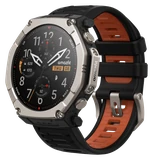
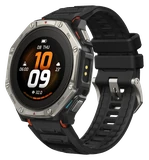
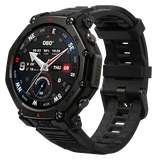
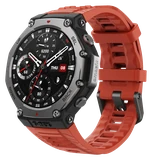

The Amazfit T-Rex Dual Solar collects light through its AMOLED display like other solar watches try to, and it also has a second panel built into the glass-ceramic caseback, with roughly twice the area of the front one. Gadgets & Wearables reported the launch Monday, and everything below comes from that single report of Zepp Health's own figures.
Nothing charges the back while it sits on your wrist, so the idea is that you take the watch off when you stop and point the caseback at the sun. Zepp Health even suggests clipping it to a backpack or a tent during long breaks. It's an odd habit to ask of an owner. It's also a very honest answer to the problem every solar watch has, which is that the useful surface faces your sleeve half the day.
Gadgets & Wearables says no major sports-watch brand has sold a solar-charging AMOLED watch before. Solar has mostly lived on dimmer, memory-in-pixel screens, where the power budget is small enough for a little light to matter.
The battery numbers are Amazfit's claims, not tests. Without sun, the rating is up to 25 days of typical use. Three hours a day at 50,000 lux on the front panel stretches that to 34 days. The same three hours on the rear panel gets you 51. GPS in its accuracy mode is rated for up to 41 hours, from a 660mAh battery.
Then there's the 180 days. That figure is for Outdoor Extreme Mode, which strips the watch back to its core outdoor tools, with continuous rear-panel exposure at 50,000 lux. It is not six months of smartwatch use, and the outlet says as much. The more practical claim is smaller: Zepp Health says sunlight alone can wake a completely flat watch, enough to get back to your maps and route. On a multi-day trip without a charger, that's the feature that counts.
The case is 51.4mm across and 16.9mm thick, and it weighs 69 grams before the strap. The screen is a 1.32-inch AMOLED at 466 by 466, rated to 3,000 nits. The bezel and four buttons are Grade 5 titanium, sapphire covers the display, and it's rated 10 ATM with support for recreational dives to 50 metres. There's a flashlight too, 200 lux with a 300-lux boost and an SOS mode.
It ships with preloaded color maps, downloadable contour and ski maps, turn-by-turn and waypoint routing, and a new elevation view that color-codes the climbs ahead. LiveShare sends your location and heading to people at home. Positioning is dual-band across six satellite systems.
The price is $649.99. Amazfit built its name by selling for less than Garmin, and at this price it doesn't. The pitch now is more hardware for the money: two solar surfaces, titanium, sapphire and real mapping. Whether that's enough to pull buyers out of Garmin's orbit depends on how the numbers hold up outside a spec sheet, and so far only the spec sheet is public.